Showing posts with label rivers. Show all posts

Thursday, November 11, 2010

A Bridge in Spain

Ever since I made my fancy header thingy at the top of this page, people have been asking about the picture. Yes, really. I swear I'm not making that up. So I've decided it's time to tell that story: where that bridge is, why I was there, and why I chose it to, er, represent my blog.


First, the location. The bridge is located in a tiny Spanish town called Barco de Avila (I'll just call it Barco. It's easier). The town is located in the province of Avila (hence the name) and is known for its beans. You can't make this stuff up. So why was I in this little, middle of nowhere-ish town? I actually stayed in a hotel called Puerto de Gredos just outside of Barco while participating in a program called Englishtown. Now I guess I have to explain what that is.


(That building on the left is where I stayed.)


Englishtown is an English immersion program aimed at Spanish (and I think now Italian) businesspeople. With a one-to-one ratio of English and Spanish speakers, people basically spend a week just talking (and playing Trivial Pursuit which is the best) in order to improve the Spanish speakers' English. It's not the best way to see Spain but it is a fun week in a four star hotel*. For those of us used to hostels, that was a welcome break. Would've been better if you didn't have to pay to use the pool. And if it was open for more than, like, an hour a day before breakfast. I signed up for Englishtown during my semester abroad; I had a month-long holiday which I mostly spent traveling around. My plan was always to end the month in Spain (I had a place to stay in Madrid for a few days) and I decided that I wanted to relax a little rather than staying in a different city every few nights. Englishtown, which is free for "Anglos" (the English speakers, obviously) provided a way to do that.

Ultimately, spending a week at Englishtown meant a week of a lot of talking and just a little sightseeing. We did get to take nice walks through the countryside--the Sierra de Gredos (mountans)--which was pretty stark, but, then again, it was April. I don't exactly know when spring comes to west-central Spain.


One of the not-highlights of the Englishtown program is Fiesta Night. Well, it wasn't a highlight for me because I (confession time) got approximately the drunkest I've ever been in my life. It was miserable and it totally wasn't my fault. I blame the elementary school principal sitting next to me at dinner who kept refilling my wine glass. Yes, I'm totally serious about that.

Fiesta Night was about halfway through the week; supposedly it's some kind of magic turning point for the Spanish speakers and there's a fancy dinner/satanic weird ritual/dance party to make that all happen. Unfortunately, that special dinner turned out to be really gross (baby squid on a stick? No thanks) and I pretty much just ate bread and not much of that. I didn't even think to order my absolute favorite Spanish food ever (which also, fortunately, happened to be an option for practically every meal) which is the amazingly delicious tortilla de patatas. So, no, I didn't enjoy Fiesta Night.

For some reason, the day after Fiesta Night is the Day of the Walk to the Village. It's a miserable experience since people tend to be a bit on the hungover side. I think the powers that be (the powers that be being a man appropriately named Richard. Figure it out) do that on purpose in order to torture us but I really wish they hadn't done it: I, for one, actually wanted to enjoy the visit and it wasn't nearly as much fun as it would've been under, uh, different circumstances.

The walk into town felt interminable, though not nearly so much as the walk back. Fortunately for me and my also hungover roommate, we had a large bottle of Diet Coke to sustain us on the way back. I braved a store with hanging animal carcasses in order to make that happen. TMI? Moving on. The town itself wasn't too impressive; it had many typical Spanish town features including:


A nice town square.


Old men sitting around in said town square.


A castle.


A church with a mystical past. If you want the story I'll try to remember it. Some other time.


Also like lots of good old towns, Barco de Avila is on a river. And that, dear readers, is where the bridge comes in. Most of Barco is on one side of the river, that church I just mentioned is on the other side. In order to get there, one must cross a bridge. Not just any bridge, but the bridge all my lovely readers (both of 'em!) see when they visit my blog.

A view from the bridge!

And there you have it. Where the bridge is and why I was there. Oh, wait, I said I'd mention why I chose it to represent my blog. You don't want to read a bunch of made-up symbolism crap, do you? I didn't think so.


*I seem to remember reading that the program doesn't use Puerto de Gredos anymore. Whatever.

Sunday, September 12, 2010

I Could Live There, Thousand Islands-Style

It's finally time for the second post on houses I want to live in. Rules/background on this here. In a nutshell, I post about really cool houses. The two featured in this post are quite near each other; both are in the Thousand Islands, a region once known as a major summer destination for very rich people. I suppose a little background on the Thousand Islands--where the salad dressing was invented*--might be appropriate. So.


The Thousand Islands region is in the St. Lawrence River, between New York and Ontario. There are actually way more than one thousand islands there, the number is closer to 1,800. The region is technically an archipelago, stretching for about fifty miles. Some of the islands are protected or parks, many contain homes, and one is even owned by Skull and Bones. Since we're talking about a river here, boats have always been pretty important. A lot of shipping occurs through the St. Lawrence though shoals (basically (mostly?) underwater islands that don't count as islands) make that a little difficult which means there are a lot of shipwrecks around. A more fun boat fact is that a lot of alcohol was smuggled over the border from Canada to the US during Prohibition. Enough?

Although the area is not too far from my home, I had only been to the Thousand Islands once, on a family trip to Toronto, and we just drove through without stopping. This summer, I decided it was time for me to finally go back and actually see the place. I had wanted to visit the area for a long time because I really wanted to see Boldt Castle, number one on the houses list:


1. Boldt Castle, Heart Island


If you're not familiar with Boldt Castle, it's an unfinished mansion located on Heart Island (originally spelled "Hart") which, thanks to George Boldt who owned the island and had the home built, actually is somewhat heart-shaped. In fact, the whole island and the house incorporate a heart theme, perhaps appropriately since George Boldt had the home built as a gift for his beloved wife, Louise. Sadly, four years after construction on the house began, Louise died. George was so grief-stricken, he immediately ordered that all work on the Castle be stopped and he never set foot there again.


Unfinished, the building lay in disrepair for many years (along with other buildings on the island) until it was acquired by the Thousand Islands Bridge Authority in 1977. In the following decades, a lot of work has been done to restore the Castle and it has seen many visitors. There are, however, a few conditions regarding the building. One is that it can never be finished. Another is that no one may ever spend the night inside the Castle because George and Louise never did and (supposedly) no one ever has. The cynic in me thinks that condition's a little unlikely since the structure did just sit there for about seventy years. Plus, I have to wonder if maybe that condition might be revoked in the event of some kind of disaster.


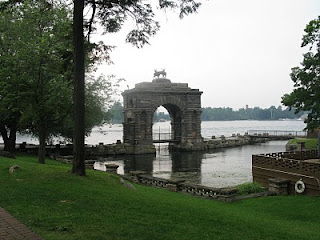
On to the building itself. Since Boldt Castle is on an island, the logical way to reach it is by boat. It's very close to the mainland; you can see the building from Alexandria Bay, the mainland NY "gateway" to the Thousand Islands region. There is a small replica of the Arc de Triomphe (with, I think, deer on top) through which visitors were initially expected to pass in order to reach the island. The arch was never used during the Boldts' lifetimes and so it has not been used since. Visitors now approach from the side.


One of the most impressive features of the building is the beautiful glass, domed ceiling that dominates the main entryway. I think the ceiling is about six stories high and, walking up the grand staircase through the center of the building, it's hard not to look up. Rooms and hallways are built around the open center of the building, many offering glimpses of what life might've been like for the very rich in the early twentieth century. This is done both through furnishings in the style of the time and through background information and artifacts of the Boldt family. The result is an interesting mix of historical home and museum.


Even more of an interesting mix results from the various stages of completion of the house's rooms. It seemed to me that the higher up one goes, the worse the rooms look. Much of the building is not restored and, presumably, some of it never will be. It's very strange to see a perfectly painted and furnished room followed by a room with boards everywhere and graffiti all over the walls.


Heart Island also has very impressive grounds. There are other buildings on the island including a funny-looking tower where the Boldt family actually did live while on the island. Unfortunately, it wasn't open so I couldn't go inside. I did walk around, though, visiting the gardens and other island buildings:


Pictured above is the Power House, meant to supply the island with power, which is now a museum. It also isn't exactly original; the building had a bit of a run-in with some fireworks with rather disastrous results. A nearby island contains the Boldt Yacht House, that's apparently very impressive though I wouldn't know. I had hoped to go there but it had started to rain and it was getting kind of late. Next visit.


2. Singer Castle, Dark Island


When I first decided to visit the Thousand Islands, as I said, I really wanted to visit Boldt Castle. I had never even heard of the less well-known Singer Castle. Reading about the boat trips around the region, I found one that went to "Singer Castle on Dark Island" and knew that I absolutely had to take it. How could I not? And I'm so glad I did as it turned out to be the highlight of my trip.


Singer Castle was built during the late 19th/early 20th century for Frederick Bourne, then president of the Singer Company, you know, the one that makes sewing machines. Hence the name Singer Castle. As in other homes both in the Thousand Islands and elsewhere (Newport, Rhode Island comes to mind), Singer Castle was originally and often referred to as a cottage. I wonder what that makes my studio apartment.


The castle's architect, Ernest Flagg, based plans for the castle on Sir Walter Scott's book, Woodstock. The result is a bizarre but amazing building with secret passages, tunnels, and even a dungeon which was not, as the tour guides joke, for punishing Bourne's children.


Another interesting fact about Singer Castle is that, although it's in the United States, it is literally just over the border. In fact, Bourne's daughter Marjorie (who owned the castle after the death of her father) kept her wine on a nearby Canadian island. Pretty ingenious considering that was during Prohibition.


Unlike Boldt Castle, Singer Castle has been cared for continuously since it was built. As a result, the whole building is furnished and in good condition, as though people still live there. In fact, the building can actually, in a way, be lived in. It's possible to book the Castle as though it were a hotel and, so they say, basically get the run of the place. I'm rather desperate to do that! As interesting as the tour/main visit was, it was only possible to see some of the passages and "secrets" built into the home.

Well, that's it for now. I do have quite a few more pictures of both "castles" but, as always, posting pictures can be a bit of a pain. If there's another (better) way to post pictures with Blogger, I'd love to hear about it

*Wikipedia doesn't necessarily think the dressing was invented in the Thousand Islands. But who cares what Wikipedia thinks?

Wednesday, December 2, 2009

400 Years of the Hudson River (part 1)

Once again, I'm adding a new feature to the blog. I'm from (upstate) New York and I've decided to (re)visit interesting places near where I live and to then post about them. Why? Because it's fun, for one. And to, well, point things out to people who may not be aware of what there is to see in my (and possibly their) part of the world. So, if you're from NY, um, hello neighbor? And if not, here's why you should visit:

First up, the Hudson River. 2009 marks the 400th anniversary of Henry Hudson sailing up the river that now bears his name. On his ship, the Half Moon, Hudson sailed up the river as far as Albany which is about 150 miles north of what's now New York City. There's a lot of interesting history about the area, the Native American tribes that lived there, and the eventual Dutch and English settlements. I, however, am going to skip most of that. For now. I may expand upon the history in later posts but for now, I'm going to focus on me.

Before I do, here's a little geography. The Hudson River begins (some sources say) at Lake Tear of the Clouds which is on Mount Marcy, the tallest mountain in New York. I remember being taught that the lake is at the top of the mountain. It isn't. I know that because I've been to the top of Mount Marcy and also because I've since read about it. The river meanders downhill and south, often as little more than a wide stream. Driving through upstate NY's Adirondack Mountains (something I'll post about later), you may cross the river often or simply drive along it. The river eventually widens, flattens, curves a bit, and flows down to New York City. Enough for now?

For most of my life, I've lived within ten or so miles of the Hudson River (and much closer, like within two blocks, when I was in college). As a result of that, I have many fond memories, pictures, and experiences that somehow involve the river. Here are a few of them:

Growing up, I often traveled to Poughkeepsie, NY to visit my grandparents who, for some unknown reason, decided to stay there even after retiring. On these visits, I always noticed a tall, imposing railway bridge slightly north of the Mid-Hudson Bridge which is used by cars. Somehow, I always knew that that railway bridge had "burned down" although I never quite understood that. How could something burn down and still be standing? I guess "caught fire" might be a better description, and that's certainly true. There was a fire on that bridge, in 1974, that stopped trains from crossing the bridge after nearly a century. In 1992, efforts began to turn the bridge into a walkway. On October 3 of this year, that walkway opened. The bridge/walkway is now a state park, allowing pedestrians to cross the Hudson between Poughkeepsie and Highland (places you may have never heard of).

I visited the bridge and crossed it (both ways) just a few weeks later. The leaves were at their peak (changing color, remember?) and the view was clear and colorful: blue sky, blue water, red and gold leaves, and enough sun to make the water shimmer. Unfortunately, I didn't bring my camera.

Not just a walkway and a state park, the bridge also contains information panels detailing the history of the bridge and the area as well as the kinds of fish found in the water. Even more than that, there's a cellphone guide where visitors can call a number and hear all sorts of information. I learned a lot including that the bridge was considered a technical wonder when it was built. It doesn't seem so special now! I seem to remember also learning that a Native American name for the river means something along the lines of "the river that flows both ways" because the river is tidal for many miles, I've heard as far as Albany. As I said, that's 150 miles.

More Information (and pictures!): http://www.walkway.org/index.php


Next up, the Hadley Parabolic Bridge (sometimes called the Hadley Bow Bridge). I hear what you're saying already: that's over the Sacandaga River, not the Hudson. You were thinking that, right? Well, if you were, you are correct. So why am I writing about it? 1. It happens to be right next to a no-longer-in-used railroad bridge. Weird, huh? 2. It's considered a technological oddity of sorts. 3. It's within spitting distance of the Hudson.


This bridge was built in a somewhat unusual style and is quite unique. It's now on the National Register of Historic Places. I'd rather not go into the technical details and history of the bridge (much too complicated and I'm not sure I completely understand it all) so instead, here's the Wikipedia page. Not that I recommend Wikipedia or have any idea if the information is accurate.
Once again, I hear what you're saying. You want to know why I visited this bridge, right? Well, I was actually driving along on a road parallel to the road with the bridge (the old road's replacement, basically) when I saw a sign for the "parabolic bridge". Naturally, I was curious. Wouldn't you be? Having decided to check it out, I found this neat looking little bridge:
The railway bridge River!
Sign!
Today's third Hudson River mention is very close geographically to the parabolic bridge. On the same day I visited the bridge, I saw Rockwell Falls (name courtesy of this fabulous site: http://www.angelfire.com/ny4/waterfalls/home.html), a small but powerful waterfall in the Hudson River.


Waterfall?


The river below the falls (I think).


More on Hudson 400: http://www.hudson400.com/
Part 2 coming soon! Along with Seattle (/Washington), BSC in the USA and Yosemite.